
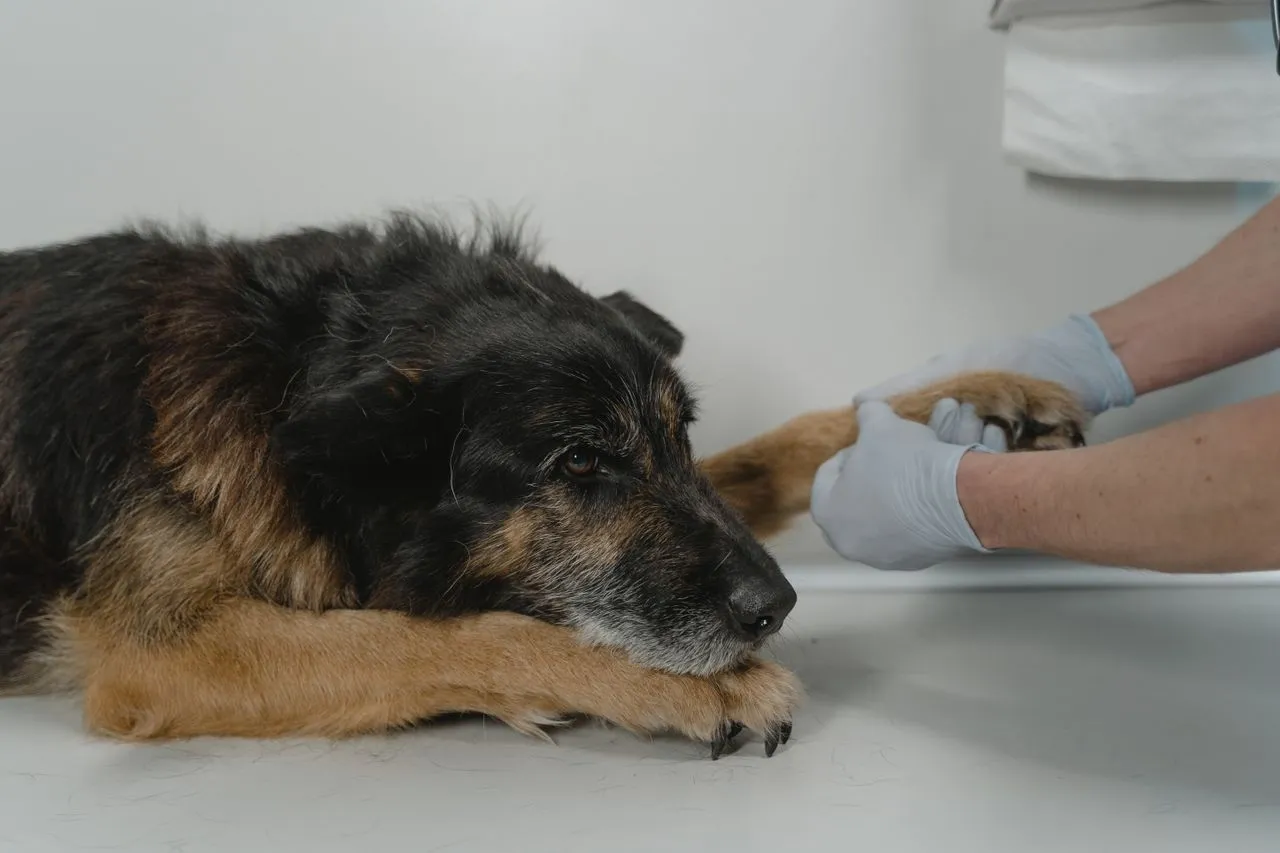
When it is an emergency and how to stay calm
This article is part of our seasonal calendar of dog health, which shows you the dangers your dog faces over the year.
Not every scrape is an emergency, but some signs mean your dog must go to the clinic immediately. These include heavy or unstoppable bleeding, breathing distress, unconsciousness, a seizure, a bloated hard belly, suspected poisoning, heatstroke, a fall from a height or an accident.
As hard as it is, the most important thing is to stay calm. Your dog senses your tension, and only when calm can you act clearly. Get an overview within a few seconds, talk to it soothingly and, if possible, have someone call the animal clinic in parallel so that everything is prepared there.
Checking the vital signs, the quick check
Before you act, a quick check of the vital signs helps. It tells you how serious the situation is. The most important normal values for an adult dog at rest:
Puppies and small breeds tend to be higher for heart rate and breathing. Also check consciousness: does your dog respond to your voice and touch? Pale, bluish or yellowish mucous membranes, a prolonged refill time or a lack of response are clear warning signs. If you note your dog's normal values once in calm moments, you will notice more quickly in an emergency when something is wrong.

Focus on the cuddles, we'll focus on the costs.
First-aid steps by situation, what to do in an emergency
Which immediate measure is right for first aid on a dog depends on the situation. With the following emergency helper you choose the situation and get the most important steps:
Whatever the situation, the rule is: you provide first aid only as far as is possible without danger to you and your dog, and afterwards you always drive to the clinic. If you suspect poisoning, our guide on poisoning and poison bait in dogs helps, and for overheating the guide on heatstroke in dogs.
Resuscitation in dogs, the basics
If your dog is no longer breathing and no heartbeat can be felt, every second counts. In its basics, resuscitation works like this:
- Lay your dog on its right side and ensure clear airways, check the mouth for foreign bodies.
- Start with firm chest compressions at the highest point of the chest, about 100 to 120 times per minute. With large dogs you press hard, with small dogs with less force.
- After every 30 compressions, give two breaths through the nose while holding the mouth closed.
- Keep going until your dog breathes again or you are at the clinic, ideally taking turns.
These steps are best practised in a course. Once you have practised the sequence with your hands, you act more confidently in an emergency.
Securing and transporting an injured dog
Pain and fear can make even the gentlest dog snap. Before you treat or transport an injured but alert dog, you therefore secure it carefully. An improvised muzzle loop made from a gauze bandage or lead can help, but only if your dog is breathing normally and there is no suspicion of breathing distress, vomiting or a problem in the mouth.
For transport, a firm surface such as a board or a sturdy blanket works well as a stretcher, especially if a spinal injury is suspected. Keep your dog warm, which prevents shock, and move it as little as necessary.
What belongs in a first-aid kit for your dog
A well-stocked first-aid kit for your dog belongs at home and in the car. These things should be in it:
- A muzzle loop or muzzle that your dog is used to
- Sterile wound dressings, gauze bandages and self-adhesive bandages
- Dressing cotton, adhesive tape and scissors with a rounded tip
- Tweezers and tick tongs or a tick card
- Disposable gloves and a wound disinfectant that your vet recommends
- Saline solution for rinsing wounds and eyes
- A digital thermometer and an emergency blanket
- The emergency numbers and the address of the nearest animal clinic
Check once or twice a year that everything is complete and within its use-by date.
Focus on the cuddles, we'll focus on the costs.
First-aid course for dog owners, is it worth it
A first-aid course for dog owners is one of the best ways to prepare for an emergency. There you practise under guidance how to apply dressings, put a dog in the recovery position and carry out resuscitation. Many vet practices, dog schools and animal welfare organisations offer such courses, often over half a day.
The difference is big: once you have done the steps yourself, you hesitate less in an emergency and act more confidently. Especially if you have a young, very active or older dog, this investment pays off.
Common emergencies and what they cost
A look at our anonymised claims data shows which emergencies affect dogs particularly often. Of around 23,700 analysed incidents from 50 euros upwards, injuries and wounds are by far the largest first-aid-relevant group. They are followed by swallowed foreign bodies with around 250 incidents, poisonings with around 170 and seizures with around 70. This classification is based on a keyword search in the case texts and should be read as a tendency.
What stands out: emergencies can become expensive. Across all cases the reimbursement is around 94 euros at the median, while individual complex emergencies with surgery and inpatient treatment reach around 6,000 euros. On top of that there are often surcharges for the emergency service outside consultation hours.
How Dalma protects you in an emergency
In an emergency, the question of what the treatment costs should not get in the way. With Dalma's pet health insurance the treatment is reimbursed within your tariff up to 4 times the GOT rate, and we cover emergency-service surcharges against proof. You choose a reimbursement of 80 or 100 percent and an annual benefit limit from 1,500 euros to unlimited.
That way you can act immediately in an emergency and decide calmly what is best for your dog.
Sources
- Dalma consumer information
- Dalma table of benefits
- RECOVER guidelines 2024, resuscitation in dogs and cats (German)
- University of Leipzig, Faculty of Veterinary Medicine, guide to resuscitation in dogs
- Internal Dalma DE claims database, dog, cases from 50 euros upwards, analysed at incident level (23,693 incidents, common emergency causes approximated by keyword, aggregated analysis, reproducibly documented)
Sources
- Dalma consumer information
- Dalma table of benefits
- RECOVER guidelines 2024, resuscitation in dogs and cats (German)
- University of Leipzig, Faculty of Veterinary Medicine, guide to resuscitation in dogs
- Internal Dalma DE claims database, dog, cases from 50 euros upwards, analysed at incident level (23,693 incidents, common emergency causes approximated by keyword, aggregated analysis, reproducibly documented)


