
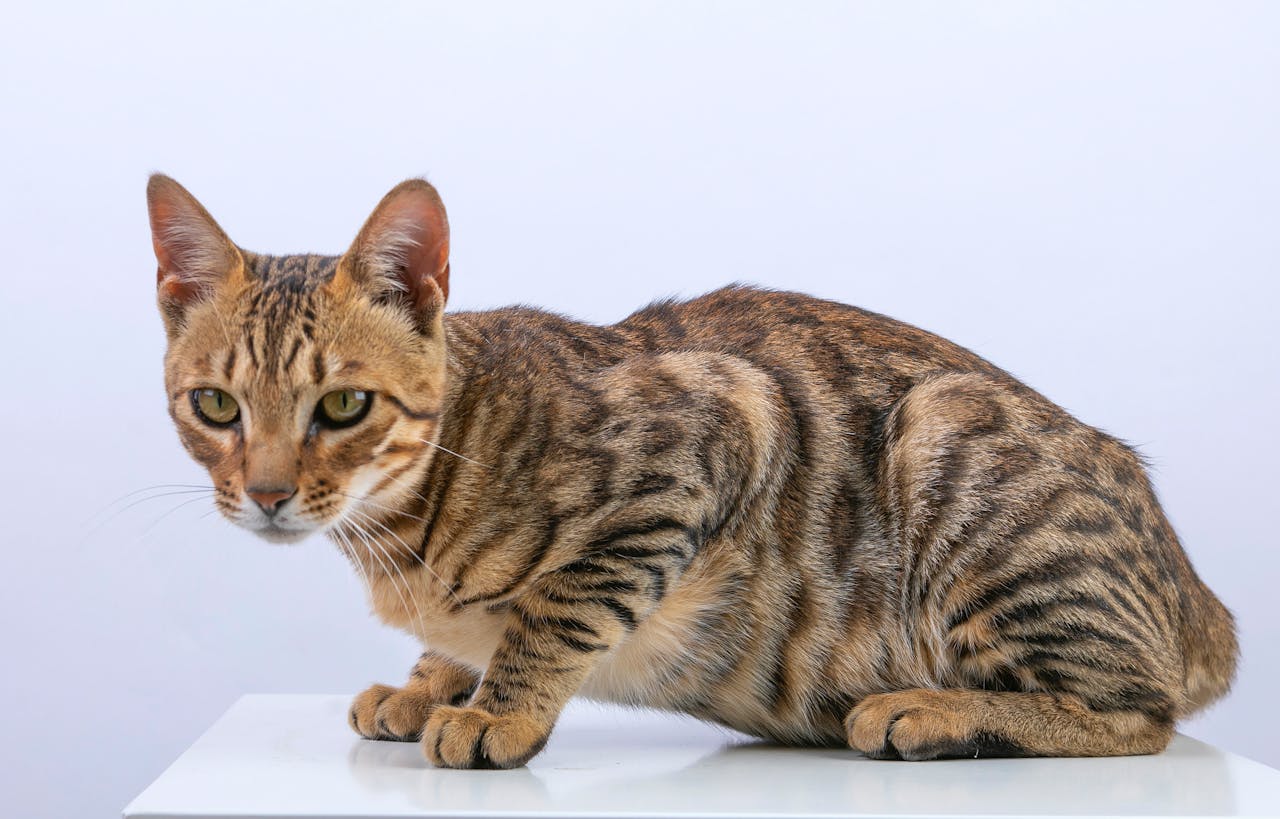
Hybrid Cat with Generational Logic: What the F-Number Really Means
The F-number is the most important characteristic when buying a Savannah – more important than size, appearance or price. It determines law, husbandry, behaviour and insurability.
The generations at a glance
Savannah generations and their legal status in Germany. Sources: Federal Species Protection Ordinance § 7, BMEL Mammal Expert Opinion, TICA standard.
Important to know:
- The generation always rises one level above the lower parent generation. Example: F2 mother × F5 father = F3 kitten.
- The F-number applies regardless of the father's filial. An F2 mother with an F7 father still produces F3 kittens.
- In outcross with wildcat, the generation falls back. An F4 cat × Serval = F1 again.
Character and demands per generation
F1 / F2: Very primal in behaviour, strong hunting drive, highly sensitive wildlife traits. Need spacious outdoor enclosure and intensive activity. Males usually sterile.
F3 / F4: Transitional generations – still wildlife status, but increasingly more "domestic" behaviour. Outdoor enclosure still sensible, males usually sterile.
F5 and higher: Legally domestic cat. Behaviour resembles a temperamental, active pedigree cat. Suitable for experienced cat owners with sufficient space and time. Males may become fertile.
Insurability: Why Only F5 and Higher Generations Are Practically Relevant
A pet health insurance requires the animal to be classified legally as a domestic cat and to live in a private household under normal conditions. For hybrid cats of generations F1 to F4, several factors stand against this:
- Mammal Expert Opinion requirements (outdoor enclosure from 50 m², height 2.5 m) make private keeping practically very limited.
- Reporting obligation to authorities under Federal Species Protection Ordinance § 7.
- Wildlife status means standard insurance for domestic cats often does not apply.
- The animals themselves are extremely expensive (F1: €15,000–50,000) and are often insured separately.
What this means: Dalma cat health insurance is aimed at domestic cats. Savannahs from F5 fall into this category and can be insured like any other pedigree cat – with the usual conditions, waiting periods and exclusions.
Tip: When buying a kitten, always check the pedigree. The generation is listed in the TICA pedigree or in the breeder's papers. An F5 or SBT is the safest choice for regular pet keeping and standard insurance.

Focus on the cuddles, we'll focus on the costs.
What Savannahs from F5 Face at the Vet
The Savannah is considered a very robust cat due to its large gene pool (through outcross practice with various breeds). Breed-typical inherited diseases are not yet documented to a significant extent – a clear advantage over heavily line-bred breeds.
Risks inherited from outcross lines
Since Savannahs have historically been crossed with various breeds (Bengal, Egyptian Mau, Ocicat, Oriental Shorthair, Maine Coon), individual genetic conditions may originate from these lines:
- HCM (Hypertrophic Cardiomyopathy): from Bengal and Maine Coon lines. Note: HCM is excluded at Dalma as a congenital condition. Acquired heart problems are covered after 30 days.
- PRA (Progressive Retinal Atrophy): from Bengal and Egyptian Mau lines. Note: Excluded as congenital eye disease.
- PK deficiency (Pyruvate kinase deficiency): known from Bengal lines. Note: Excluded as inherited disease.
Recommendation when buying a kitten: ask the breeder about genetic tests of parent animals for HCM, PRA and PK-Def. Reputable breeders perform these tests routinely.
General topics like in any active cat
- Injuries from jumps and hunting drive: Savannahs jump over two metres high. Secured balconies and no uncontrolled outdoor access are essential. Covered after 2 days waiting period.
- Gastrointestinal topics: active cats with high metabolism, food changes can be sensitive. Covered after 30 days.
- Dental conditions: as in all cats, FORL and gingivitis possible. Covered after 12 months.
- General infections: cat flu, FIP, leukosis – provided vaccination protection is in place.
The cost ranges listed above are based on the German Veterinary Fee Schedule (GOT 2022) and typical market prices in German veterinary practices. Actual costs may vary depending on the practice, the scope of treatment and the chosen GOT rate (1x to 4x).
Surgery Insurance or Full Cover: Which Plan Suits the Savannah?
1. Surgery insurance for Savannahs
Covers costs for surgical procedures – e.g. after jump injuries, tumour surgery or neutering (outside the preventive care budget). Dalma includes:
- Surgical procedures for illness or accident
- Pre-op diagnostics up to 30 days before surgery
- Post-op clinic stays up to 30 days after surgery
- Medication, bandages and aftercare
- Physiotherapy and alternative treatments up to 30 days post-op
- Dental surgery after waiting period
- Emergency accommodation up to €250 per year
2. Cat health insurance (full cover) for Savannahs
Covers diagnostics, treatments, medication and preventive care. 80–100% reimbursement, annual limit from €1500 to unlimited. Includes:
- Diagnostics and medical examinations
- Prescribed medication and treatments
- Unlimited physiotherapy
- Alternative treatments such as homeopathy or acupuncture
- Behavioural therapy up to 5 hours per year
- Telemedicine via FirstVet
- Preventive care budget for vaccinations, dental care, deworming (from €1,500 annual limit)
Assessment: For a Savannah from F5, full cover is particularly worthwhile, as the breed is active and jump-strong despite its robust gene pool. Unlimited physiotherapy and alternative treatments are plus points for an intensely moving cat.
What Does Savannah Insurance Cost at Dalma?
- Cat health insurance: from approx. €16 per month
- Surgery insurance: from approx. €8 per month
As of April 2026. Dalma offers 15% discount when insuring multiple pets. Neutering/spaying claimed via the preventive care budget.
From age 10, the reimbursement rate for illnesses decreases by 5% annually. Accident reimbursement remains unchanged.
Waiting Periods for the Savannah
- 2 days for accidents
- 14 days for surgeries
- 30 days for medical treatments
- 12 months for FORL, gingivitis and periodontitis
- 12 months for HD/ED
- 18 months for patellar luxation
Pre-existing conditions are excluded. Preventive care budget is available from day 1.
Focus on the cuddles, we'll focus on the costs.
What Is Not Covered for the Savannah
For the Savannah, general feline exclusions apply, as well as inherited disease risks from outcross lines:
- HCM (Hypertrophic Cardiomyopathy) – inherited from Bengal/Maine Coon lines
- PRA (Progressive Retinal Atrophy) – inherited from Bengal/Egyptian Mau lines
- PK deficiency – inherited from Bengal lines
- Brachycephalic syndrome (not relevant for Savannahs, general exclusion)
- PKD (Polycystic Kidney Disease)
- Congenital eye diseases
- Persistent deciduous teeth
- Epilepsy
- Osteoarthritis
- Diseases preventable by vaccination (cat flu, feline parvovirus, leukosis, FIV)
Acquired heart, eye, gastrointestinal and respiratory conditions are covered after the waiting period. Important: For hybrid cat generations before F5, standard insurance is not possible – these animals fall under wildlife or special regulations.
Claims Process at Dalma
100% digital. Upload invoice via app, 8-day deadline. Reimbursement target 48 hours (contractually up to 5 working days). Up to 4x GOT rate including emergency surcharges. Free choice of vet worldwide. Telemedicine via FirstVet free and unlimited. Neutering and spaying can be claimed via preventive care budget.
Frequently Asked Questions About Savannah Insurance
Which generation Savannah can I actually insure?
Savannahs from the F5 generation are legally classified as domestic cats in Germany and can be insured at Dalma like any other pedigree cat. F1 to F4 fall under the Mammal Expert Opinion and are considered wildlife – standard cat insurance is generally not possible here.
What does F1, F2, F3 mean for the Savannah?
The F-number indicates the generation since crossbreeding with a Serval. F1 = direct descendant of a Serval (50% wild blood content). F2 = grandchild of a Serval (25%). F5 = ca. 3% wild blood content and counts as a domestic cat.
Are Savannahs healthy?
Yes, the Savannah is considered a very robust breed – the large gene pool (through outcross practice with Bengal, Egyptian Mau, Ocicat etc.) significantly reduces the risk of breed-typical inherited diseases. Individual genetic conditions from outcross lines may still occur.
Are HCM and PRA covered for the Savannah?
No. HCM (Hypertrophic Cardiomyopathy) and PRA (Progressive Retinal Atrophy) are excluded as congenital/inherited conditions. Acquired heart problems are covered after 30 days, provided they are not based on a congenital HCM.
My male can be sterile – is that an insurance case?
Males in Savannahs are typically sterile up to F5 generation. This is a congenital characteristic (Haldane's rule) and not an insurance case. Sterility treatment is not covered.
What is SBT and is it relevant for insurance?
SBT (Stud Book Traditional) means at least three generations are pure Savannahs. Possible only from F4. For insurance, only the F-generation is relevant – not the SBT status.
My Savannah kitten comes from abroad – is it still insurable?
Yes, provided it is from F5 generation onwards and may be legally kept in Germany. Important: complete vaccination status (especially rabies for EU import) and valid pet documents. Pre-existing conditions are excluded.
How old does a Savannah get?
Life expectancy with good care is 15 to 20 years. Due to the large gene pool, the breed is considered very long-lived. Early insurance is particularly worthwhile because many active years follow.
Is there a deductible at Dalma?
No. Dalma has no deductible. Depending on the plan, 80–100% of eligible costs are reimbursed.
Does my Savannah stay insured after an expensive treatment?
Yes. Dalma waives the right to cancel after a claim.
Sources and Further Information
The veterinary costs mentioned in this article are reference values. Actual costs are governed by the German Veterinary Fee Schedule (GOT) and may vary depending on the practice, the scope of treatment and the chosen GOT rate (1x to 4x).
Official sources on the German Veterinary Fee Schedule (GOT 2022):
- Full text of the GOT 2022: https://www.gesetze-im-internet.de/got_2022/
- German Veterinary Association (BTK): bundestieraerztekammer.de – official body with information on GOT, emergency service and billing
- German Federal Ministry of Agriculture (BMLEH): bmleh.de/DE/themen/tiere/got.html – background on the 2022 GOT amendment
Sources on Savannah generations and hybrid cat law:
- Federal Species Protection Ordinance § 7: reporting obligation for hybrid cats
- BMEL Mammal Expert Opinion: minimum requirements for wildcat hybrids up to F4
- TICA Standard: generation definition and SBT registration
- LGL Bavaria: conference proceedings on hybrid cats, Serval content and sterility
Sources and Further Information
The veterinary costs mentioned in this article are reference values. Actual costs are governed by the German Veterinary Fee Schedule (GOT) and may vary depending on the practice, the scope of treatment and the chosen GOT rate (1x to 4x).
Official sources on the German Veterinary Fee Schedule (GOT 2022):
- Full text of the GOT 2022: https://www.gesetze-im-internet.de/got_2022/
- German Veterinary Association (BTK): bundestieraerztekammer.de – official body with information on GOT, emergency service and billing
- German Federal Ministry of Agriculture (BMLEH): bmleh.de/DE/themen/tiere/got.html – background on the 2022 GOT amendment
Sources on Savannah generations and hybrid cat law:
- Federal Species Protection Ordinance § 7: reporting obligation for hybrid cats
- BMEL Mammal Expert Opinion: minimum requirements for wildcat hybrids up to F4
- TICA Standard: generation definition and SBT registration
- LGL Bavaria: conference proceedings on hybrid cats, Serval content and sterility


