
Can my dog travel in the cabin? The weight logic up to 8 kg
This article is part of our guide to Travelling with a dog.
Whether your dog can come into the cabin depends on weight with almost all airlines. The rule of thumb: if your dog together with the bag weighs up to about 8 kg, it may usually come into the cabin. If it is heavier, it travels in the hold. With the following check you can see at a glance what applies to your dog:
Importantly, the 8 kg means the total weight, so dog plus bag plus padding. If you are close to the limit, it is best to weigh it at home beforehand. Each airline sets the exact limit and permitted dimensions itself, so check them before booking.
Cabin or hold, the difference
In the cabin your dog travels right beside you, in a soft bag under the seat in front. For most dogs this is the most relaxed option, because you are nearby. Places are limited, though, and often only a few animals are allowed per flight, so booking early pays off.
The hold sounds more alarming than it is. With reputable airlines the animal area is climate-controlled and pressure-regulated, so similar to the cabin. Your dog travels on the same flight as you, in a sturdy IATA crate. You hand it over at check-in and collect it again at the destination at a special counter.
| Criterion | Cabin | Hold |
|---|---|---|
| Which dogs | up to about 8 kg including bag | heavier than about 8 kg |
| Carrier | soft bag under the seat in front | sturdy IATA hard-shell crate |
| Closeness to the owner | right beside you | separate, but the same flight |
| Places | limited, book early | after registering in good time |

Focus on the cuddles, we'll focus on the costs.
Flying with a large dog, what is really possible
Many owners of large dogs hope to be able to take their companion into the cabin. Honestly, that is not possible with the vast majority of airlines. As soon as the dog and bag together weigh more than about 8 kg, the cabin is off-limits, and a large dog travels in the hold.
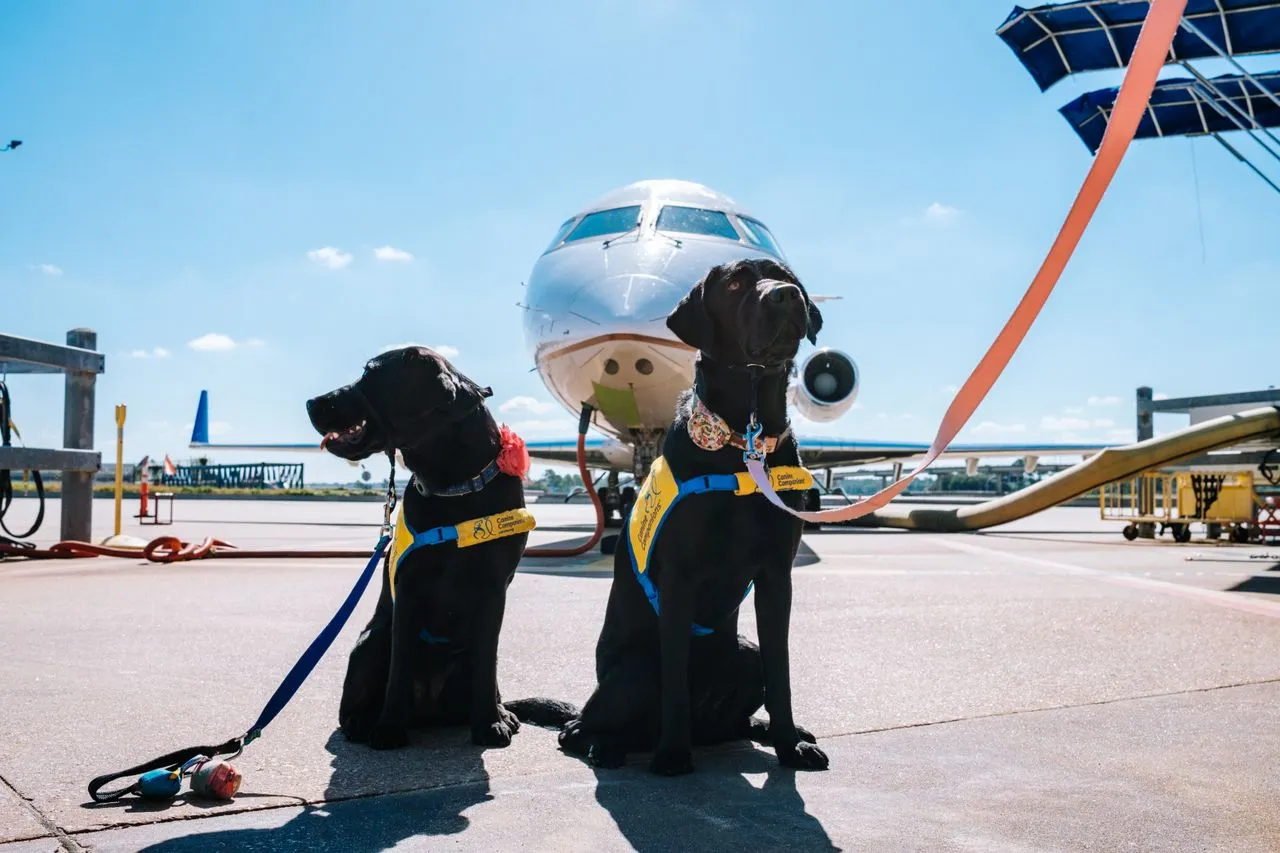
The only regular exception are assistance dogs. They may travel in the cabin free of charge with almost all airlines, even if they are larger, but special documentation is required for this. Occasionally there are specialised charter offers where larger dogs are allowed in the cabin, but these are rare and expensive. For most large dogs, well-prepared transport in the hold is the realistic route.
One recent development is worth a look: in Italy the aviation authority relaxed the rules in 2025, so that individual airlines such as ITA Airways allow somewhat heavier dogs in the cabin on certain routes, depending on the route up to around 10 kg. Such exceptions are airline- and route-dependent, however, and can change, so always check them directly with the airline.
The right transport crate for cabin and hold
The right crate depends on whether your dog travels in the cabin or in the hold.
For the cabin: You need a soft, leak-proof bag that fits under the seat in front. With Lufthansa and Eurowings the maximum size is, for example, 55 x 40 x 23 cm, and slightly different with other airlines. The material must be bite-proof, breathable and easy to close, and hard-shell crates are usually not allowed in the cabin.
For the hold: Here a sturdy hard-shell crate compliant with the IATA Live Animals Regulations is mandatory. It must have the top and bottom screwed together with metal bolts, a waterproof base with an absorbent liner, and fixed water and food bowls that can be filled from the outside. Your dog must be able to stand upright, turn around and lie down.
Tip: Buy the crate in good time and let your dog get to know it calmly as a cosy retreat, long before heading to the airport.
Airlines at a glance
The rules are similar but differ in detail. This overview helps with comparison; always check the exact requirements and prices directly with the airline.
| Airline | Dog in the cabin | Larger dogs in the hold |
|---|---|---|
| Lufthansa, Swiss, Austrian | up to 8 kg including bag | yes, short-nosed breeds excluded |
| Eurowings | small dogs up to 8 kg | no animal transport in the hold |
| Condor | up to 8 kg including bag | yes, short-nosed breeds fully excluded |
| TUIfly | small dogs, registration required | yes |
| Air France, KLM | up to 8 kg including bag | yes |
| Ryanair, EasyJet, Wizz Air | no animals except assistance dogs | none |
What this means: If you want to fly cheaply and take your dog along, classic budget airlines are not an option. Better to plan with an airline that has experience in animal transport.
Which dogs are not allowed to fly
Not every dog is allowed to fly, regardless of weight. Three groups are affected:
- Short-nosed breeds such as the Pug, French and English Bulldog, Boxer or Pekingese. They are more prone to stress, heat and pressure changes. Some airlines exclude them from the hold, others such as Condor entirely.
- Listed dogs such as the Pit Bull or American Staffordshire Terrier. Depending on the airline, restrictions or a muzzle in the crate apply.
- Puppies younger than the minimum age. To and from Germany, dogs are ready to travel at 15 weeks at the earliest.
If in doubt, clarify the case with the airline before booking; that spares nasty surprises at check-in.
Focus on the cuddles, we'll focus on the costs.
Documents and registration before the flight
On the plane, the normal travel documents apply too. Within the EU your dog needs a microchip, an EU pet passport and a valid rabies vaccination. You can read more about this in the guides on EU pet passport, rabies vaccination in dogs and the entry requirements by country.
In addition, you must register your dog with the airline, usually 48 to 72 hours before departure. Often transport is only possible on direct flights. Even if you check in online, you register your dog again at the airport directly at the counter.
How to prepare your dog for the flight
Good preparation makes the flight considerably more relaxed for your dog:
- Get it used to the crate early, with a blanket, a familiar smell and positive experiences.
- Avoid sedatives. They can affect circulation and breathing, especially in the hold. For an anxious dog, talk to your vet about gentle alternatives.
- Feed it only lightly a few hours before the flight and take it for a good long walk beforehand.
- Allow enough time at the airport, since you check in at the counter and go through security.
- Put something absorbent in the crate and attach bowls for longer flights.
Costs and how Dalma protects your dog
The costs depend on the airline, route and weight. Roughly, taking a dog in the cabin often costs between 50 and 100 euros per leg, and the hold frequently between 120 and 300 euros. Your airline will tell you the exact prices.
Whatever the route, your dog's health is the most important thing. With Dalma's pet health insurance your dog is covered abroad too, worldwide except for the USA, the US territories and Canada, also during a temporary stay abroad of up to five years. If your dog falls ill or gets injured at the destination, the treatment costs are reimbursed within your tariff up to 4 times the GOT rate; you choose 80 or 100 percent and an annual benefit limit from 1,500 euros to unlimited.


